
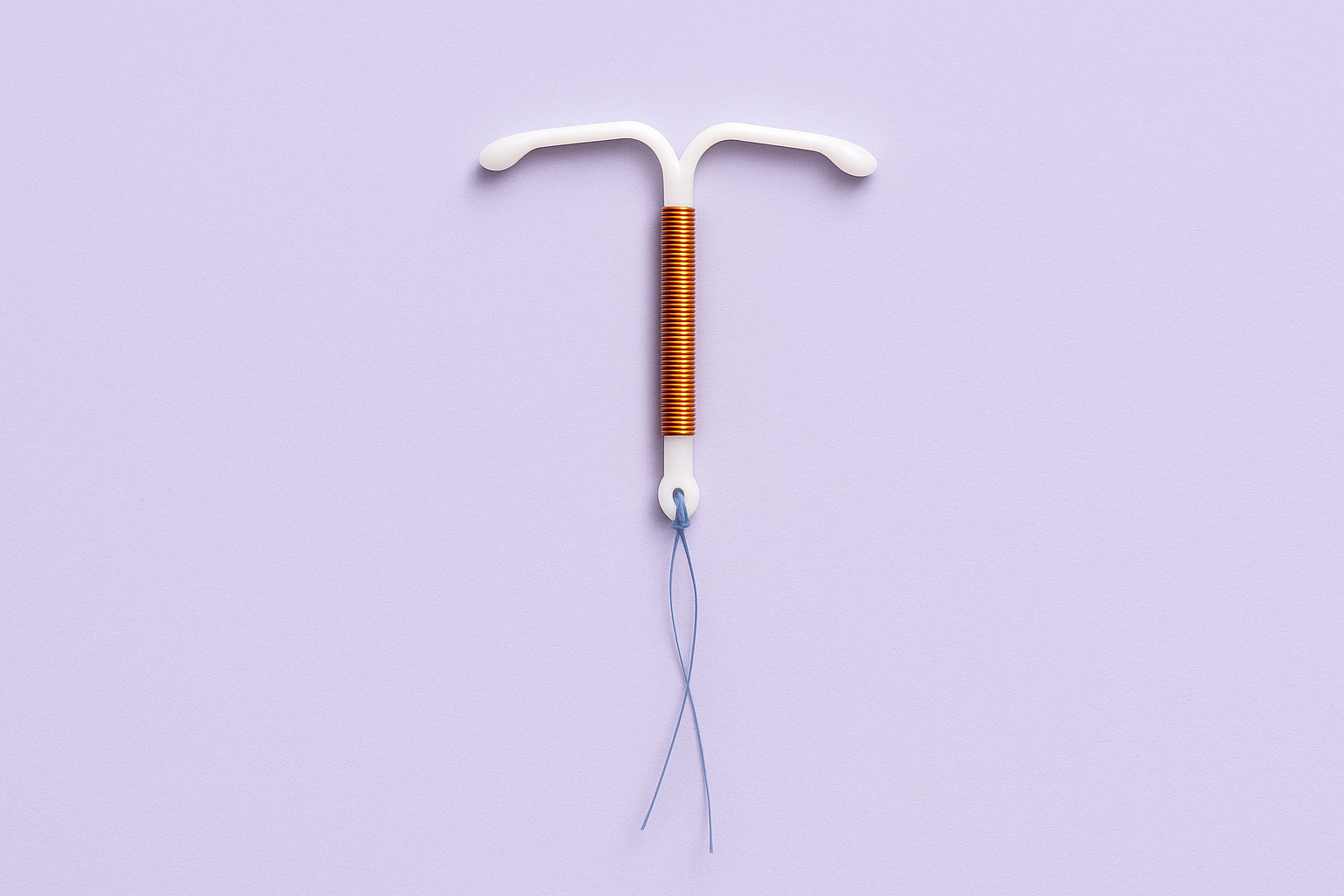
Copper IUD
Zero hormones. Loads of staying power.
Gets an A+ in pregnancy prevention.
The cheat Sheet
COMMON BRAND NAMES
Load 375, TT380 Short, TT380 Standard, NOVA T 380, Paragard (US only)
PREVENTING PREGNANCY
More than 99% effective
STARTING ON THIS METHOD
Get an STI check beforehand. Once you’re clear, you’ll need to book an appointment with your doctor or a specialist nurse to have it inserted. This can be done under local or general anesthetic (this costs more).
LAST FOR
Immediate protection once it’s in so you won’t need to use any other contraception. Lasts for 5-10 years.
HORMONES
No synthetic hormones
STIS
No protection against STIs
PERIODS
May make periods heavier or last longer
ACNE/SKIN
Doesn’t impact skin
MOOD/EMOTIONS
No known effect on mood
PREGNANCY AFTER REMOVAL
It is possible to get pregnant immediately post-IUD removal.
VISIBILITY
Not visible
FINANCIAL INVESTMENT
One off - Insertion cost plus the cost of the device. Medicare rebate available
The copper IUD aka intrauterine device (IUD) is a tiny (we’re talking 50 cent piece size), T-shaped plastic device wrapped in copper wire that is inserted into the uterus. It has one mission and one mission only: prevent pregnancy.
Unlike the hormonal IUDs, the copper IUD doesn’t release any synthetic hormones. Copper and sperm aren’t friends, creating an environment that is inhospitable to sperm. It stops those swimmers from moving properly and makes fertilisation very unlikely. It also changes the uterine lining, making it harder for the fertilised egg to implant.
The copper IUD is also a suitable method of emergency contraception. This means that if you do have unprotected sex or your current method of contraception (ie. condom breaks, missed a pill etc) fails then getting the copper IUD inserted can be a backup option to stop any potential pregnancy in its tracks. However, the copper IUD is a long term contraceptive method (it can last for up to 5-10 years in the uterus), so if you are after a quick fix, maybe look into the emergency contraceptive pill.
- Folks with naturally lighter, regular and/or manageable periods
- The roamers, the forgetters, the live-in-the-moment-ers
- Anyone on a long-term baby break (or skipping it altogether
- Inserted by a doctor or nurse, and yes, it can be a VERY painful procedure.
- No STI protection. If you need both, you’ll still want condoms.
- May not be for you if you get frequent infections (like UTIs), have a copper allergy, or Wilson’s disease, low iron levels, endometriosis or heavy periods. Chat to your doctor as there may be a more suitable method for you.
.gif)
The not-so-fun stuff
Common side effects
Let’s be real, no contraceptive method is perfect. With the copper IUD, side effects aren’t one-size-fits-all. Some people barely notice it’s there, while others might deal with heavier periods or more cramping. Everyone’s body responds differently and every response is valid.
We want you to have the full picture so you can decide if it’s right for your body, not just what looks good on paper.
So here it is: the good, the meh, and the stuff worth keeping an eye on.
Because the copper IUD is completely hormone-free, it won’t cause hormone-related side effects like mood changes or breast tenderness. Any side effects you might notice, like heavier bleeding or more cramping are related to the device itself, not hormones, and often improve within 3–6 months as your body adjusts.
Some of the most commonly reported ones include:
- Changes in menstrual bleeding (heavier periods)
- Painful periods
- Spotting or irregular bleeding
- Pain during insertion
The Lowdown is a contraception review platform where real people share their lived experiences with different birth control methods, including the copper IUD. It’s a goldmine of lived experience.
- Substantely heavier periods
- Period-like cramps
- Changes to vaginal discharge
- Tender breasts
- Thrush
Less Common But important to know
There’s a small risk of PID in the first 20 days after your IUD is inserted, not because of the IUD itself, but because if there’s an untreated STI hanging around, bacteria can get pushed up into the uterus during insertion. The chance of this happening is around 0.5% or less. After this initial period, your risk is the same as anyone without an IUD.
To reduce the risk of this happening, make sure you get an STI check appointment AND get the results back too before your insertion appointment. If there’s anything to treat, you’ll want to sort it all out first!
Sometimes (happens in about 1 in 20 users), the IUD can partially or fully slip out, especially in the first 3 to 6 months after insertion. You might notice this, or you might not (string checks are handy for this very reason).
You might be more at risk if you:
- Have heavy or irregular periods
- Are getting it soon after giving birth, especially within 6 weeks
- Are young or haven’t given birth (some research suggests a slightly higher risk)
- Experience a less-than-ideal insertion (make sure the person who is inserting the IUD knows what they’re doing!)
This one sounds scary (and it kind of is), but it’s very rare. It happens in 1 in every 500 insertions. Perforation means the IUD accidentally pokes through the uterine wall, usually during the insertion procedure.
You might be more at risk if you are:
- Breastfeeding (lower estrogen means softer uterine wall and therefore a slightly higher risk)
- Undergoing a postpartum insertion (especially within 12 weeks of giving birth)
- Get an Inexperienced providers (technique really matters here)
What happens if it does perforate?
You may not notice right away. It’s often picked up via missing strings, pelvic pain, or during a scan. Sometimes it sorts itself out, sometimes it needs surgical removal. Most people recover without any long-term issues.
Pregnancy with a copper IUD is very rare, but if it does happen, there’s a higher chance it could be ectopic, when a pregnancy grows in the fallopian tube instead of the uterus. It can be serious, so if you ever think you might be pregnant with an IUD in place, check in with your healthcare provider as soon as you can.

Pre insertion Prep
Wear ultra comfy clothes, nothing too tight around your stomach (calling all granny panties).
Bring a pad with you to the appointment to use afterwards if there's a little bit of spotting.
Call upon a support person to pick you up after the appointment.
If you're not going under general anaesthetic:
- Take pain relief around 30-60 minutes before your appointment to help minimise cramping.
- Have a light meal and drink plenty of water beforehand to avoid feeling lightheaded afterwards.
Relaxation techniques to use when you are mid IUD insertion
To help make it a little more bearable, here’s some relaxation techniques that will help take your mind off the pain and discomfort and ease anxiety and stress. These breathing techniques help tell your brain that you are not in a dangerous situation where flight, fight, freeze or fawn response is more likely to kick in.
No bears in the cave here, just Trudy the gyno ha!
What to do mid-insertion:
- Inhale for 4 seconds
- Hold your breath for 4 seconds
- Exhale for 4 seconds
- Hold for 4 seconds, then repeat
What to do mid-insertion:
Picture yourself lying on a soft, fluffy cloud, floating effortlessly through the sky. With each inhale, imagine the cloud lifting you higher. With each exhale, feel your body releasing tension into the air.
Why it helps:
It creates a sense of weightlessness, helping you relax your pelvic muscles and reduce pain perception.
Prep before the appointment:
Plan what you are going to do post IUD insertion. Think low-impact ‘happy place’. This could be indulging in your favourite food, curled up in bed binge watching your favourite tv series or snuggling with Meow-bert the long haired ragdoll. Organise this with your support person so they are onboard with the plan.
What to do mid-insertion:
Imagine yourself an hour from now in your pre-planned happy place.
Why it helps:
Your brain believes what you tell it - so by focusing on the post-procedure relief, you shift away from discomfort in the moment.
Now I know this can be challenging, especially when it can feel impossible to take your mind off the physical pain you may be experiencing in that moment.
However, a couple of things that can make it easier:
- Practice whatever technique you wish to use before the insertion procedure so you are well equipped once you are there.
- Communicate this with your support person beforehand and if needed (and if they are in the room with you), ask them to coach you through the prompts/techniques.
What to actually expect during the IUD insertion
Although it feels like a lifetime when you are in it, the IUD insertion typically takes 5-10 minutes.
1. Prep (hello anticipatory anxiety)
First of all, 3 deep breaths. You got this.
Positioning: You'll lie on your back on an examination table, with your feet up in stirrups, similar to a standard pelvic exam.
Duration: A few minutes.
Sensation: Typically minimal discomfort (phew!)
2. Speculum insertion (creating the runway)
What happens: A speculum (think duck beak-shaped device) is gently inserted into your vagina to hold it open and provide access to your cervix.
Duration: Approximately 1-2 minutes.
Sensation: You may feel pressure or a stretching sensation in the vagina.
3. Cervical stabilisation (opening act)
What happens: Your healthcare provider uses an instrument called a tenaculum (kind of looks like large tweezers) to grasp and stabilise the cervix.
Duration: A few seconds for getting it in the right position.
Sensation: This can cause a sharp cramp or a brief pinch, and sometimes mild spotting. Totally normal.
Pain management: Sometimes you can get a topical anesthetic to help reduce the pain at this step.
4. Uterine measurement (aka sounding the place out)
What happens: A thin rod, called a uterine sound, is inserted through the cervix to measure the depth and orientation of your uterus. This is done so that the healthcare provider places the IUD in the right spot (some would say this is quite important ha!).
Duration: Less than a minute.
Sensation: This may cause a brief, sharp cramp as the instrument touches the top of the uterus.
5. IUD insertion (the main event)
What happens: The IUD, contained within an applicator tube, is inserted through the cervix into the uterus. Once in place, the IUD is released, and the applicator is removed.
Duration: A few minutes.
Sensation: You may experience cramping or a sense of pressure during this step. This is normally the most painful part, but it means its almost done! You are on the home stretch now.
6. Home stretch
What happens: Your healthcare provider trims the IUD strings so they extend slightly into the vagina.
Duration: Less than a minute.
Sensation: Normally minimal to no discomfort. You’re done! Phew!
Insertion - what’s right and what’s wrong
- You can feel the strings (or your healthcare provider confirms they’re in place).
- Mild to moderate cramping or spotting in the days or weeks following insertion.
- Slightly heavier periods at first
- Cramps may linger, but they should feel dull and achy, not sharp or stabbing.
- You can’t feel the strings, or they suddenly feel longer or shorter. This could mean the IUD has shifted or expelled (aka: it’s evacuated its cozy home and is now squatting in your cervix or vaginal canal). Sometimes strings naturally curl around the cervix. If you can’t feel them but feel fine, your provider can check placement with an ultrasound.
- You experience pain during sex or your partner feels the hard part of the IUD. This may suggest the IUD is sitting too low or has moved.
- Funky-smelling discharge, chills, or a fever could be early signs of infection. Normal discharge is okay, but if it’s new, persistent, or comes with pain, check in.
- You expel the IUD. If you see it in your underwear, in the toilet, or on the floor (it happens), it’s no longer protecting you from pregnancy. You’ll need a new one or a backup form of contraception.
- You have severe, sharp, or worsening pain. This could mean the IUD is in the wrong position or, in rare cases, has perforated the uterus. You know your body, trust yourself!
- Heavy, continuous bleeding. If you are soaking through a pad or tampon every hour or experiencing prolonged bleeding beyond your normal cycle.
0
Pain-free, baby!
1
Pain-free, baby!
2
I can feel it, but it’s no biggie.
3
It’s annoying, but I can tune it out.
4
It’s constant and starting to wear me down.
5
It’s hard to focus. I’m uncomfortable and kind of done.
7
I need support — I can’t manage this on my own. Might be time to call the doctor.
8
This is serious. I’m struggling to cope and thinking about urgent care.
9
I can’t move or think straight. This feels emergency-level.
10
The worst pain I’ve ever felt. This is an emergency. Hospital, now.
0
A cute drop
1
Light flow
2
Moderate
3
Heavy
4
Very heavy
5
Flood zone
The pain-o-metre
A lot of us downplay our pain.
Especially when it comes to periods, cramping, or anything uterus-adjacent. We’re taught to tough it out, to call it “normal,” even when it’s not. Why? Because for a very long time, the world told us to.
That’s exactly why we created this Pain-O-Metre, to help you check in with your body, validate what you’re feeling, and remind you that asking for help isn’t dramatic. It’s smart.
This scale is here to help you check in with your body - it’s not a substitute for medical advice. If you’re ever unsure, always check in with a healthcare provider.
The Blood-o-metre
This scale is a guide, not a diagnosis. Everyone’s body and baseline are different, and pain or bleeding that’s affecting your daily life, mental health, or ability to function is reason enough to check in with a medical professional.
When in doubt - Trust your gut, and seek support.
Post insertion procedure
You did it! Your uterus has a new roomie! How are you feeling? If the answer is “not amazing,” that’s okay. You’ve just had something placed inside your body...sooo it's understandable if you feel crappy!
Let’s walk through what the next few days and weeks might look like with your new copper IUD.
24 hours after
Cramping & discomfort
Mild to moderate cramping and low back pain are very normal after insertion. Think: annoying period vibes with a side of “I’d like to stay horizontal.” Pain usually starts to ease within a few hours to a day.
Spotting or light bleeding
Your uterus just had a visitor. Light spotting or brown discharge is super common and totally normal.
48 hours after
Lingering cramps
Cramps may continue for another day or two, usually less intense than right after insertion.
Heat pack, comfy clothes, and your favourite snack is highly recommended.
Spotting continues
Spotting may still be happening, but it should start to taper off. For some, it may linger on and off for a few weeks - annoying, but not uncommon.
1 week after
Body in adjustment mode
By now, most cramping and bleeding will be easing up. Some people feel completely back to normal, while others still notice mild symptoms. Both are okay.
Time to check the strings
If you feel comfortable, gently insert a clean finger into your vagina and feel for the strings, they’ll feel like thin fishing line.
Feel the strings? All good.
Can’t find them, or they feel much longer or shorter? Contact your healthcare provider.
1 month after
Changes to your period
You may notice changes in your menstrual cycle, such as heavier bleeding and increased cramping during periods. This is common with copper IUDs. Some people find it improves with time, others disagree. Gauge it for yourself!
Time for a follow up appointment
At the 4-6 week mark, a quick check-up helps make sure:
- Your IUD is still in place
- You’re healing well
- Any symptoms you’re unsure about can be addressed
Where this info comes from
This page was created using guidance from trusted Australian and international health organisations, clinical guidelines, and peer-reviewed research. These sources support the medical accuracy, accessibility, and lived experience approach behind this content.
- BetterHealth Channel - Intrauterine devices (IUD)
- Family Planning NSW - Copper IUD
- Healthdirect Australia - Intrauterine contraceptive device (IUD)
- Healthdirect - inserting an IUD
- The Women’s - Intra Uterine Device (IUD)
- Healthline - Everything you need to know about IUD insertion
- Sexual Health Victoria - Intrauterine Device (IUDs)
- Sexual Health Victoria - Information for those having an IUD inserted at Sexual Health Victoria
- SHINE SA – Intra-Uterine Device (IUD)
- MSI Australia – Copper IUD
- Body Talk – Copper IUD
- Family Planning Tasmania - Intrauterine Device (IUD)
- FSRH (Faculty of Sexual and Reproductive Healthcare, UK) - Copper Coil/IUD
- NHS UK - What is an IUD (intrauterine device) or copper coil?
- Brook - The non-hormonal (copper) coil
- Planned Parenthood - IUD
- Cleveland Clinic - Paragard (Copper IUD)
- WebMD - Paragard (Copper) - Uses, side effects, and more
- Kids Health - The IUD
- Drugs.com
- Achilles, S. L., Austin, M. N., Meyn, L. A., et al. (2018). Impact of contraceptive initiation on vaginal microbiota. American Journal of Obstetrics and Gynecology, 218(6), 622.e1–622.e10. https://doi.org/10.1016/j.ajog.2018.02.017
- Brown, B. P., Feng, C., Tanko, R. F., Jaumdally, S. Z., Bunjun, R., Dabee, S., Happel, A.-U., Gasper, M., Nyangahu, D. D., Onono, M., Nair, G., Palanee-Phillips, T., Scoville, C. W., Heller, K., Baeten, J. M., Bosinger, S. E., Burgener, A., Passmore, J.-A. S., Heffron, R., & Jaspan, H. B. (2023). Copper intrauterine device increases vaginal concentrations of inflammatory anaerobes and depletes lactobacilli compared to hormonal options in a randomized trial. Nature Communications, 14(1), 499. https://doi.org/10.1038/s41467-023-36002-4
- Ellington, K., & Saccomano, S. J. (2020). Recurrent bacterial vaginosis. The Nurse practitioner, 45(10), 27–32. https://doi.org/10.1097/01.NPR.0000696904.36628.0a
- Hubacher, D., Chen, P. L., & Park, S. (2009). Side effects from the copper IUD: do they decrease over time?. Contraception, 79(5), 356–362. https://doi.org/10.1016/j.contraception.2008.11.012
- Mohllajee, A. P., Curtis, K. M., & Peterson, H. B. (2006). Does insertion and use of an intrauterine device increase the risk of pelvic inflammatory disease among women with sexually transmitted infection? A systematic review. Contraception, 73(2), 145–153. https://doi.org/10.1016/j.contraception.2005.08.007
- Peebles, K., Kiweewa, F. M., Palanee-Phillips, T., Chappell, C., Singh, D., Bunge, K. E., Naidoo, L., Makanani, B., Jeenarain, N., Reynolds, D., Hillier, S. L., Brown, E. R., Baeten, J. M., Balkus, J. E., & MTN-020/ASPIRE study team (2021). Elevated Risk of Bacterial Vaginosis Among Users of the Copper Intrauterine Device: A Prospective Longitudinal Cohort Study. Clinical infectious diseases : an official publication of the Infectious Diseases Society of America, 73(3), 513–520. https://doi.org/10.1093/cid/ciaa703
- Otten, C. (2021). The sex ed you never had. Allen & Unwin.