

Hormonal IUD
A tiny overachiever that hangs out in your uterus, does the hormone thing, and lets you forget about birth control for literally years.
Gets an A+ in pregnancy prevention.
The cheat Sheet
COMMON BRAND NAMES
Mirena, Kyleena, Skyla, Liletta, Jaydess
PREVENTING PREGNANCY
99% effective
STARTING ON THIS METHOD
The hormonal IUD is inserted by a healthcare provider during an in-clinic procedure.
LAST FOR
If it’s inserted during the first 7 days of your period, it’s effective immediately. Otherwise, you’ll need to use backup contraception (like condoms) for 7 days. Depending on the brand, hormonal IUDs last between 3 to 8 years.
HORMONES
Yes, contains synthetic hormones - progestin
STIS
No protection against STIs
PERIODS
Your period may change - most people experience lighter, less frequent bleeding over time, and some stop getting periods altogether. Spotting or irregular bleeding is common in the first few months.
ACNE/SKIN
Can improve and/or worsen your acne/skin
MOOD/EMOTIONS
May improve or impact your mood, depending on how your body responds to the hormones.
PREGNANCY AFTER REMOVAL
You can get pregnant as soon as the hormonal IUD is removed. Fertility returns quickly for most people.
VISIBILITY
Hormonal IUDs are not visible externally. There are no marks or signs on the body. Two small strings sit inside the vagina, but they’re tucked up near the cervix and usually can’t be felt unless someone is specifically checking for them, like a doctor.
FINANCIAL INVESTMENT
Hormonal IUDs like Mirena and Kyleena are subsidised through Medicare and the PBS, but there are still some out-of-pocket costs. You may also need to pay for the consultation and insertion, unless your clinic bulk bills.
The hormonal IUD is a small (about the size of a gummy bear, but with way more responsibility), T-shaped device made of medical-grade plastic that’s placed inside your uterus. Once it’s in, it slowly releases a low, steady dose of progestin (a synthetic version of the hormone progesterone).
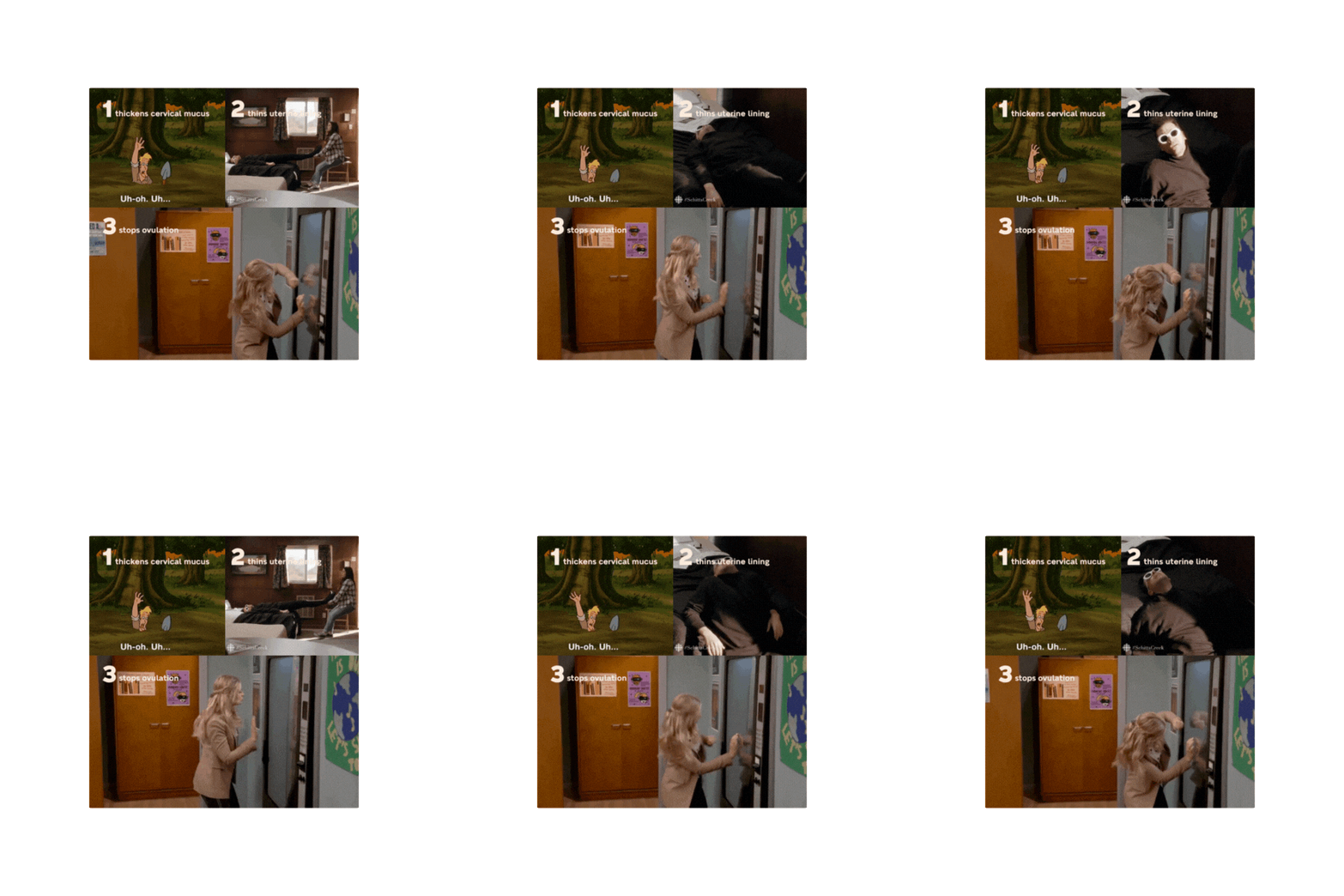
This hormone prevents pregnancy in three main ways:
- Thickens cervical mucus
Imagine the cervix is the entrance to a fancy garden party, and sperm are uninvited guests. Normally, the gate (cervical mucus) is open with a smooth path. But under the influence of progestin, that path turns into a pit of quicksand; thick, dense, and nearly impossible to cross. Most sperm get stuck before they even make it to the gate. Poor things, the party is popping off!
- Thins the uterine lining
The uterus usually fluffs up its lining like a cozy bed, getting ready to welcome a fertilised egg. The hormone in the IUD strip the bed and take away the welcome mat, making it much harder for anything to settle in and stay. Because guess what, this hotel has no vacancies!
- (Sometimes) stops ovulation
For some people, the hormonal IUD also tells the ovaries to chill out and skip ovulation altogether. But this effect can vary depending on the IUD brand and your body.
- The free spirits, the forgetters, and anyone who wants to put pregnancy prevention firmly in the out-of-sight, out-of-mind category.
- Anyone dealing with heavy or painful periods who wants some sweet, sweet relief.
- The folks who want long-term, budget-friendly birth control that just gets on with it.
- It won’t protect you from STIs, so if that’s a possibility, consider teaming it up with condoms - double act, double peace of mind.
- Insertion can be painful (we won’t sugarcoat it), but pain management options exist, including the “knock me out completely” route if that’s more your style.
- For the first 3-6 months, there can be some ‘growing pains’ after the hormonal IUD is inserted, including spotting or frequent bleeding.
The not-so-fun stuff
Common side effects
Let’s be honest. No contraceptive method is perfect. And when it comes to hormonal contraception, side effects can feel like a bit of a lucky dip. What one person barely notices, another might really struggle with. Everyone responds differently - physically, emotionally, mentally and every response is valid.
We want you to have the full picture so you can make a decision that works for your body, not just what looks good on paper.
So here it is: the good, the meh, and the stuff worth keeping an eye on.
Because the hormonal IUD releases progestin locally (not systemically like the pill), many people have fewer hormone-related side effects overall and if they do experience side effects, normally, they go away after 3-6 months of the hormonal IUD being inserted, as your body adjusts.
Some of the most commonly reported ones include:
- Irregular bleeding or spotting
- Lighter periods or no periods over time
- Headaches or migraines
- Mood changes
- Acne (can worsen or improve)
- Breast tenderness
- Cramping or discomfort after insertion
The Lowdown is a contraception review platform where real people share their lived experiences with different birth control methods, including the hormonal IUD. It’s a goldmine of lived experience: helpful, human, and full of the stuff you won’t find in a medical pamphlet.
- Periods that disappear or spotting that overstays its welcome
- Skin getting clearer...or not
- More stable moods...or emotional ups and downs
- Libido changes (up, down, or sideways)
- Discomfort or pain after insertion (sometimes intense, but short-lived)
- “Settling in” time takes a few months
Less Common But important to know
There’s a very small risk, about 1 in 200 people, or 0.5% of developing PID in the first 20 days after IUD insertion. But it’s not the IUD itself that causes it. The concern is that if you have an untreated STI, like chlamydia or gonorrhea, the process of inserting the IUD can accidentally push bacteria up into the uterus (yeah, not fun).
After those first 3 weeks though, your risk of PID is the same as anyone without an IUD. To reduce this risk, get an STI test before your insertion appointment and make sure you get the all clear on the results. If there is something to treat, do it first!
Around 10-22% of people using a hormonal IUD develop ovarian cysts, especially within the first year. These are usually functional cysts, meaning they form when the ovary doesn't release an egg as expected during ovulation.
Hormonal IUDs don’t always stop ovulation, especially the lower-dose ones like Kyleena, Jaydess, or Skyla. And when ovulation does happen but the follicle doesn’t rupture properly (it’s meant to do this), that little egg sac can hang around and grow into a cyst. It’s your body doing its hormonal dance, with a few missteps.
These cysts are:
- Non-cancerous
- Often harmless and symptom-free
- Usually go away on their own within a few months
- Occasionally causes pelvic pain, bloating, or a feeling of heaviness
In very rare cases, they can rupture and cause more acute pain, but that’s uncommon. Most people don’t even know they have them unless they show up on a scan.
This is rare, occurring in about 1 in 500 users, but it’s something to be aware of, so you know what to look out for.
Uterine perforation happens when the IUD accidentally pierces through the wall of the uterus, either fully or partially (ouch). This typically occurs at the time of insertion, although it may not be noticed right away.
Who’s more at risk?
- People who are breastfeeding
- Those who’ve had a baby in the last 6 weeks
- People with a tilted or unusually shaped uterus
- Cases where the insertion technique is difficult or complicated
What it may feel like:
Some people have no symptoms at all, and perforation is only picked up during a follow-up or imaging. If symptoms do show up, they may include:
- Sharp or sudden pelvic pain during or after insertion
- Persistent cramping that doesn’t ease after a few days
- Heavier bleeding than expected
- Pain during sex
- Strings feel shorter, longer or can’t be felt at all
- In rare cases: fever, nausea, or signs of infection
If something doesn’t feel quite right, trust your instincts and check in with your healthcare provider. They can do a quick pelvic exam or ultrasound to make sure the IUD is sitting where it should be.
Expulsion is when the IUD partially or fully slips out of place, either falling lower in the uterus or coming out entirely. It happens in about 2-10% of users and typically within the first 3 months after insertion.
It’s more likely if the IUD is placed:
- Soon after giving birth
- In people who are under 25
- In those with heavy or painful periods
Sometimes it’s obvious, sometimes not, but here are a few things to look out for:
- New or unusual cramping
- Heavier bleeding or spotting after things had settled
- A change in string length, or not being able to feel the strings at all (if you were checking before)
- A general sense that something feels different down there
If you think that your IUD might have moved, it's always worth a check-in with your healthcare provider. They can confirm placement with a quick exam or ultrasound and help you figure out your next step if it has been expelled.
Hormonal contraception is not a one-size-fits-all so when it comes to how your mood will be affected by synthetic hormones, it's a bit of a trial and error. If you’ve ever felt like your mental health is connected to your hormones, you’re not imagining it.
Some people using hormonal IUDs report mood swings, low mood, or anxiety. Others feel no change at all, or even more emotionally steady than before. The research is mixed, but a growing number of studies suggest that people with a history of things like depression, anxiety, or PMDD may be more sensitive to hormonal shifts.
Because the hormonal IUD releases progestin locally (not systemically like the pill or injection), most people experience fewer mood-related side effects compared to other hormonal methods. But that doesn't mean side effects are impossible or “in your head.” Your lived experience is valid.
If you notice changes in your mood after getting a hormonal IUD, whether that’s a subtle shift or something more significant, it’s worth tracking and bringing up with a healthcare provider. You are the expert on your body, and you deserve care that takes mental health seriously.
You’re not overreacting. You’re paying attention. And that matters. Go you good human!
Your hormones explained
Localised vs non-localised hormones
Methods like hormonal IUDs and the vaginal ring
- These are designed to release hormones directly to the uterus or cervix, with the goal of staying “local.”
- Ovulation may or may not be suppressed, depending on the method and you as a human!
- They’re often described as “low impact” but there’s some grey area to that.
Methods like the combined pill, injection and implant
- Hormones are delivered into your bloodstream and circulate throughout your entire body.
- That means they can influence your brain, breasts, skin, bones, libido, mood, appetite…pretty much everything.
- Ovulation is usually fully suppressed.
- There’s a strong potential for both physical and psychological effects, because these hormones touch every system.
Even local methods like the hormonal IUD aren’t truly local. A portion of those hormones still enter your bloodstream. And once they’re in? They’re catching an Uber straight to your central nervous system, aka your brain, which is basically a hormone sponge.
Your brain has estrogen and progesterone receptors scattered throughout:
- Amygdala (emotion)
- Hippocampus (memory)
- Prefrontal cortex (decision-making, motivation)
- Hypothalamus (hormone regulation)
- Brainstem (autonomic nervous system)
That’s a lot of big words but in other words, your brain is not just along for the ride, it’s driving the car.
If you’ve ever said:
- “I don’t feel like myself on birth control.”
- “The IUD was meant to be low-impact, but I still felt off.”
- “It helped my skin but wrecked my libido.”
- “I feel calm, but numb.”
You’re not imagining it. You’re experiencing the full-body, full-mind reality of synthetic hormones - even from methods that are “local”.
No matter how the hormones are absorbed, through your uterus, your skin, your gut, or a tiny implant in your arm, synthetic hormones affect all of you. That doesn’t make them bad. It just makes them pretty powerful.
Knowing how they work gives you the info you need to figure out what’s right for you!

Pre insertion Prep
Wear ultra comfy clothes, nothing too tight around your stomach (calling all granny panties).
Bring a pad with you to the appointment to use afterwards if there's a little bit of spotting.
If you're not going under general anaesthetic:
- Take pain relief around 30-60 minutes before your appointment to help minimise cramping.
- Have a light meal and drink plenty of water beforehand to avoid feeling lightheaded afterwards.
Relaxation techniques to use when you are mid IUD insertion
To help make it a little more bearable, here’s some relaxation techniques that will help take your mind off the pain and discomfort and ease anxiety and stress. These breathing techniques help tell your brain that you are not in a dangerous situation where flight, fight, freeze or fawn response is more likely to kick in.
No bears in the cave here, just Trudy the gyno ha!
What to do mid-insertion:
- Inhale for 4 seconds
- Hold your breath for 4 seconds
- Exhale for 4 seconds
- Hold for 4 seconds, then repeat
What to do mid-insertion:
Picture yourself lying on a soft, fluffy cloud, floating effortlessly through the sky. With each inhale, imagine the cloud lifting you higher. With each exhale, feel your body releasing tension into the air.
Why it helps:
It creates a sense of weightlessness, helping you relax your pelvic muscles and reduce pain perception.
Prep before the appointment:
Plan what you are going to do post IUD insertion. Think low-impact ‘happy place’. This could be indulging in your favourite food, curled up in bed binge watching your favourite tv series or snuggling with Meow-bert the long haired ragdoll. Organise this with your support person so they are onboard with the plan.
What to do mid-insertion:
Imagine yourself an hour from now in your pre-planned happy place.
Why it helps:
Your brain believes what you tell it - so by focusing on the post-procedure relief, you shift away from discomfort in the moment.
Now I know this can be challenging, especially when it can feel impossible to take your mind off the physical pain you may be experiencing in that moment.
However, a couple of things that can make it easier:
- Practice whatever technique you wish to use before the insertion procedure so you are well equipped once you are there.
- Communicate this with your support person beforehand and if needed (and if they are in the room with you), ask them to coach you through the prompts/techniques.
What to actually expect during the IUD insertion
Although it feels like a lifetime when you are in it, the IUD insertion typically takes 5-10 minutes.
1. Prep (hello anticipatory anxiety)
First of all, 3 deep breaths. You got this.
Positioning: You'll lie on your back on an examination table, with your feet up in stirrups, similar to a standard pelvic exam.
Duration: A few minutes.
Sensation: Typically minimal discomfort (phew!)
2. Speculum insertion (creating the runway)
What happens: A speculum (think duck beak-shaped device) is gently inserted into your vagina to hold it open and provide access to your cervix.
Duration: Approximately 1-2 minutes.
Sensation: You may feel pressure or a stretching sensation in the vagina.
3. Cervical stabilisation (opening act)
What happens: Your healthcare provider uses an instrument called a tenaculum (kind of looks like large tweezers) to grasp and stabilise the cervix.
Duration: A few seconds for getting it in the right position.
Sensation: This can cause a sharp cramp or a brief pinch, and sometimes mild spotting. Totally normal.
Pain management: Sometimes you can get a topical anesthetic to help reduce the pain at this step.
4. Uterine measurement (aka sounding the place out)
What happens: A thin rod, called a uterine sound, is inserted through the cervix to measure the depth and orientation of your uterus. This is done so that the healthcare provider places the IUD in the right spot (some would say this is quite important ha!).
Duration: Less than a minute.
Sensation: This may cause a brief, sharp cramp as the instrument touches the top of the uterus.
5. IUD insertion (the main event)
What happens: The IUD, contained within an applicator tube, is inserted through the cervix into the uterus. Once in place, the IUD is released, and the applicator is removed.
Duration: A few minutes.
Sensation: You may experience cramping or a sense of pressure during this step. This is normally the most painful part, but it means its almost done! You are on the home stretch now.
6. Home stretch
What happens: Your healthcare provider trims the IUD strings so they extend slightly into the vagina.
Duration: Less than a minute.
Sensation: Normally minimal to no discomfort. You’re done! Phew!
Insertion - what’s right and wrong
- You can feel the strings (or your healthcare provider confirms they’re in place).
- Mild to moderate cramping or spotting in the days or weeks following insertion.
- Slightly heavier periods at first are normal with copper IUDs, while hormonal IUDs may cause lighter periods, irregular bleeding, or no bleeding at all over time.
- Cramps may linger, but they should feel dull and achy, not sharp or stabbing.
- Your body adjusts gradually, some mood or cycle changes are normal in the first few months, especially with hormonal IUDs.
- You can’t feel the strings, or they suddenly feel longer or shorter. This could mean the IUD has shifted or expelled (aka: it’s evacuated its cozy home and is now squatting in your cervix or vaginal canal). Sometimes strings naturally curl around the cervix. If you can’t feel them but feel fine, your provider can check placement with an ultrasound.
- You experience pain during sex or your partner feels the hard part of the IUD. This may suggest the IUD is sitting too low or has moved.
- Funky-smelling discharge, chills, or a fever could be early signs of infection. Normal discharge is okay, but if it’s new, persistent, or comes with pain, check in.
- You expel the IUD. If you see it in your underwear, in the toilet, or on the floor (it happens), it’s no longer protecting you from pregnancy. You’ll need a new one or a backup form of contraception.
- You have severe, sharp, or worsening pain. This could mean the IUD is in the wrong position or, in rare cases, has perforated the uterus. You know your body, trust yourself!
- Heavy, continuous bleeding. If you are soaking through a pad or tampon every hour or experiencing prolonged bleeding beyond your normal cycle
-
0
Pain-free, baby!
1
Pain-free, baby!
2
I can feel it, but it’s no biggie.
3
It’s annoying, but I can tune it out.
4
It’s constant and starting to wear me down.
5
It’s hard to focus. I’m uncomfortable and kind of done.
7
I need support — I can’t manage this on my own. Might be time to call the doctor.
8
This is serious. I’m struggling to cope and thinking about urgent care.
9
I can’t move or think straight. This feels emergency-level.
10
The worst pain I’ve ever felt. This is an emergency. Hospital, now.
0
A cute drop
1
Light flow
2
Moderate
3
Heavy
4
Very heavy
5
Flood zone
The pain-o-metre
A lot of us downplay our pain.
Especially when it comes to periods, cramping, or anything uterus-adjacent. We’re taught to tough it out, to call it “normal,” even when it’s not. Why? Because for a very long time, the world told us to.
That’s exactly why we created this Pain-O-Metre, to help you check in with your body, validate what you’re feeling, and remind you that asking for help isn’t dramatic. It’s smart.
This scale is here to help you check in with your body - it’s not a substitute for medical advice. If you’re ever unsure, always check in with a healthcare provider.
The Blood-o-metre
This scale is a guide, not a diagnosis. Everyone’s body and baseline are different, and pain or bleeding that’s affecting your daily life, mental health, or ability to function is reason enough to check in with a medical professional.
When in doubt - Trust your gut, and seek support.
Post insertion procedure
You did it! Your uterus has a new roomie! How are you feeling? If the answer is “not amazing,” that’s okay. You’ve just had something placed inside your body...sooo it's understandable if you feel crappy!
Let’s walk through what the next few days and weeks might look like with your new hormonal IUD.
24 hours after
Cramping & discomfort
Mild to moderate cramping and low back pain are very normal after insertion. Think: annoying period vibes with a side of “I’d like to stay horizontal.” Pain usually starts to ease within a few hours to a day.
Spotting or light bleeding
Your uterus just had a visitor. Light spotting or brown discharge is super common and totally normal.
48 hours after
Lingering cramps
Cramps may continue for another day or two, usually less intense than right after insertion.
Heat pack, comfy clothes, and your favourite snack is highly recommended.
Spotting continues
Spotting may still be happening, but it should start to taper off. For some, it may linger on and off for a few weeks - annoying, but not uncommon.
1 week after
Body in adjustment mode
By now, most cramping and bleeding will be easing up. Some people feel completely back to normal, while others still notice mild symptoms. Both are okay.
Time to check the strings
If you feel comfortable, gently insert a clean finger into your vagina and feel for the strings, they’ll feel like thin fishing line.
Feel the strings? All good.
Can’t find them, or they feel much longer or shorter? Contact your healthcare provider.
1 month after
Period changes kick in
With hormonal IUDs, your period may:
- Become lighter or irregular
- Show up as just spotting
- Disappear altogether
All of these are normal responses to the progestin hormone. If your bleeding increases over time or you’re feeling off, bring it up with your healthcare provider.
Time for a follow up appointment
At the 4-6 week mark, a quick check-up helps make sure:
- Your IUD is still in place
- You’re healing well
- Any symptoms you’re unsure about can be addressed
Where this info comes from
This page was created using guidance from trusted Australian and international health organisations, clinical guidelines, and peer-reviewed research. These sources support the medical accuracy, accessibility, and lived experience approach behind this content.
- FSRH (Faculty of Sexual and Reproductive Healthcare, UK) - Hormonal Coil/IUS
- WHO – Medical Eligibility Criteria for Contraceptive Use, 5th edition
- NHS UK - IUS (intrauterine system) or hormonal coil
- Brook - The Hormonal Coil
- Planned Parenthood - Hormonal IUDs
- Mayo Clinic - Hormonal IUD (Mirena)
- WebMD - Mirena
- Alvergne, A., & Lummaa, V. (2010). Does the contraceptive pill alter mate choice in humans? Trends in Ecology & Evolution, 25(3), 171–179. DOI: 10.1016/j.tree.2009.08.003.
- Brønnick, M. K., Ottowitz, W. E., Pfeifer, G., & Pletzer, B. (2020). Systematic review of neuroimaging studies on hormonal contraceptives. Frontiers in Psychology, 11, 1560. DOI: 10.3389/fpsyg.2020.556577
- Lauring, J. R., Lehman, E. B., Deimling, T. A., Legro, R. S., & Chuang, C. H. (2016). Combined hormonal contraception use in reproductive-age women with contraindications to estrogen use. American Journal of Obstetrics and Gynecology, 215(3), 330.e1–330.e7. https://doi.org/10.1016/j.ajog.2016.03.047
- Pletzer, B., & Kerschbaum, H. H. (2014). 50 years of hormonal contraception—Time to find out what it does to our brain. Frontiers in Neuroscience, 8, 256. DOI: 10.3389/fnins.2014.00256
- Skovlund, C. W., Morch, L. S., Skovlund, C. W., et al. (2016). Association of hormonal contraception with depression. JAMA Psychiatry, 73(11), 1154–1162. https://jamanetwork.com/journals/jamapsychiatry/fullarticle/2552796
- World Health Organization, International Agency for Research on Cancer. (2007). Combined estrogen–progestogen contraceptives and combined estrogen–progestogen menopausal therapy (IARC Monographs on the Evaluation of Carcinogenic Risks to Humans, Vol. 91). https://publications.iarc.fr/Book-And-Report-Series/Iarc-Monographs-On-The-Identification-Of-Carcinogenic-Hazards-To-Humans/Combined-Estrogen--Progestogen-Contraceptives-And-Combined-Estrogen-Progestogen-Menopausal-Therapy-2007
- Otten, C. (2021). The sex ed you never had. Allen & Unwin.
- Hill, S. E. (2019). This is your brain on birth control: The surprising science of women, hormones, and the law of unintended consequences. Avery.