

Fertility Awareness Method
Daily cycle sleuthing to know when to go for it, and when to park it.
Gets a C+ in pregnancy prevention.
The cheat Sheet
COMMON BRAND NAMES
Cycle tracking, natural family planning, cycle syncing
PREVENTING PREGNANCY
Perfect use (combining all the methods) is up to 95-98% effective. However, typical use is more around 76-88% effective.
STARTING ON THIS METHOD
You’ll need to track your cycle consistently for at least 6 months before using any of the FAM’s as a reliable contraception.
LAST FOR
As long as your cycles stay regular, though it’s less reliable in adolescence or near menopause.
HORMONES
No synthetic hormones
STIS
No protection against STIs
PERIODS
No effect to periods
ACNE/SKIN
No effect to acne/skin
MOOD/EMOTIONS
No effect to mood/emotions
PREGNANCY AFTER REMOVAL
Because fertility awareness is a tracking method, not a hormonal or physical contraceptive, you can get pregnant at any time if you have unprotected sex, especially during your fertile window.
VISIBILITY
Not visible but works best with clear communication with your sexual partner(s)
FINANCIAL INVESTMENT
If you're using an app to track your cycle, there might be a monthly subscription fee and a one-off cost for a basal thermometer, but besides that, this method is completely free!
Fertility Awareness Methods (FAMs) are all about getting to know your body and your cycle, so you can work with it, not against it. The intention is that you figure out which days of the month you’re most likely to get pregnant, and then you either avoid unprotected sex on those days (if you don’t want a baby), or aim for those days (if you do). Simple-ish.
Your body gives you little clues throughout your cycle about when you’re fertile, you just have to learn how to read them. This is where tracking comes in.
You can use an app, a journal, or your Notes app (if you thrive off chaos), but the point is to dial into your cycle consistently and accurately. Like you would brushing your teeth every night or doing a morning poop. Ovulation (aka when one of your ovaries releases an egg) is the big moment and the days just before and after it are your most fertile window. If you want to avoid pregnancy, this is your no-go zone for unprotected sex, or using a barrier method like condoms to reduce your chances of getting pregnant.
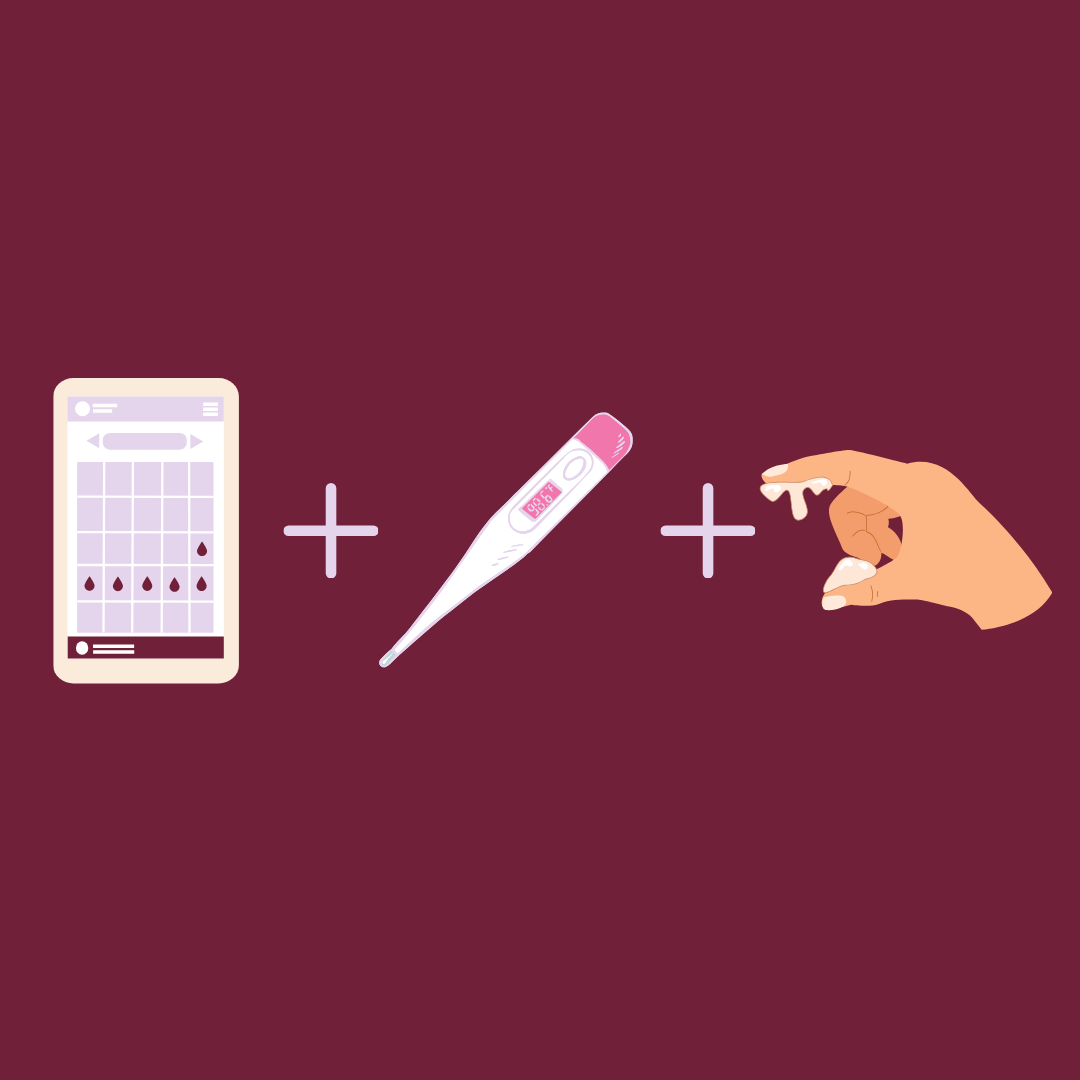
There are a few different ways to track your fertility. Some people stick to one, others mix and match to make this method more effective for preventing pregnancy.
The calendar method
You track your cycle on a calendar or app to guess when you’re ovulating based on past cycles. Best for people with fairly regular periods.
The temperature method
Every morning, before you even get up to go to the toilet, you take your basal body temperature. After you ovulate, your temp goes up a smidge and over time, you’ll see a pattern. Nerdy but pretty cool.
The cervical mucus method
Yep, we’re talking about vaginal discharge. Every day, you check your mucus (just a quick wipe and peek). Around ovulation, it’s clear, slippery, and stretchy, like raw egg whites. That’s your body saying: “Fertile alert!”
The symptothermal method
A combo of the above - mucus, temperature and calendar method. It’s more effort but also more accurate. Like using both Maps and Waze when you’re driving somewhere new.
- The organised, app-loving types who wake up at the same time every day, live by their digital calendar and don’t mind a bit of daily homework.
- The hormone-free, ah la natural crew who want to feel deeply in tune with their cycle.
- And anyone whose period runs like clockwork (give or take a minute).
- Takes a bit of commitment from everyone involved; you'll need a backup method (like condoms) on fertile days.
- It can take a couple of months to get into the groove and trust your tracking. We recommend getting some training from a professional when starting out.
- And a big one: it does not protect against STIs.
The not-so-fun stuff
Fertility awareness method FLAWS
The Fertility Awareness Method is hormone-free and non-invasive (love that for us), so there are zero medical side effects. No mood swings, no mystery bleeding, no hormonal rollercoasters.
However, it isn’t all sunshine and rainbows either! Here are a few things to keep in mind.
You’ll need to check in with your body every single day. We’re talking temp-taking, mucus-noting, and calendar-updating. If you're more “vibes and winging it” than becoming a “daily data diva” might be a stretch.
In real life (where people forget things, sleep in, and go on holidays), it’s around 76-88% effective. So not ideal if a surprise pregnancy would be a major drama.
This method won't protect you from sexually transmitted infections, so if that's a factor, condoms are still your bestie.
Especially on fertile days when it’s either don't have sex or use some sort of barrier method like condoms. If your partner isn’t into planning (or condoms), there could be some unnecessary tension.
Stress and/or anxiety, sickness, jet lag, shift work, drinking alcohol and big nights out on the town, certain medications, exercising a lot, broken sleep - all of it can throw off your body’s cues. So if you’re in a chaotic life season, tracking may be trickier.
If your cycle likes to surprise you every month, it’s harder to spot the fertile window accurately. Not impossible, just more advanced level. Like level 100 on Candy Crush.
If you are nearing menopause or have just started getting your period, this may not be the most effective method of contraception.
Starting your fAM journey
The different methods explained
To use the calendar method as contraception, you need to track your cycle for at least 6 months first (so if you’ve been faithfully logging periods into your app, you’re already halfway there.)
Ovulation tends to happen about 14 days before your next period, but this is something you probably don’t want to just guess. To work out your fertile window, you’ll use your shortest and longest cycle lengths from the past 6-12 months, then calculate the earliest and latest days you could ovulate. Because sperm can survive up to 5 days and an egg for about 24 hours, you’ll want to steer clear of unprotected sex for several days before and just after ovulation.
Your app might colour these days red or give you a little warning icon. Avoid unprotected sex then, or use a backup method like condoms. Apps can make the maths easier, but choose one that’s actually designed for contraception, not just general cycle tracking.
This one’s for the morning people (or anyone who doesn’t mind a quick science experiment before coffee).
Before ovulation, your basal body temperature (BBT) is lower. After ovulation, it rises by around 0.2–0.5°C and stays higher until your next period. You won’t feel the change, it’s subtle but it’s a solid clue to where you are in your cycle.
To use this method:
- Get yourself a basal thermometer (more sensitive than a regular fever one).
- Take your temperature every morning before you move, scroll, or even think.
- Log it in your app or chart. Do this for a few months and you’ll start to see a pattern.
Your fertile days are before the sustained rise in temperature. You can consider yourself in the infertile phase after your temperature has stayed higher for three mornings in a row. Those post-rise days are generally safer for unprotected sex.
A cute reminder: things like illness, alcohol, late nights, or travel can mess with your readings, so consistency is key.
Your cervical mucus is basically your body’s built-in fertility newsfeed. Throughout your cycle, your discharge changes in texture and appearance. You can check it by:
- Looking at your undies
- Wiping with white toilet paper before you wee
- Using clean fingers to gently check inside the entrance of your vagina
Then rub it between your thumb and forefinger like a curious scientist, you’re feeling for consistency.
The general pattern
- Period: Hard to check mucus, so assume you’re fertile unless you know your usual “safe” pattern from tracking for a while.
- After your period: A few dry or sticky/creamy days. These can be safe if they’re your normal pattern and you’ve confirmed it over at least 3 cycles.
- Getting closer to ovulation: Mucus increases, feels wetter, and may be sticky, creamy, cloudy, or watery. These are fertile days.
- Ovulation (peak): Mucus is clear, slippery, and stretchy like raw egg white, or feels very wet - your most fertile time.
- After ovulation: Mucus thickens, gets tacky, or you go back to dry days. Count three days like this after your last fertile day before it’s considered safe again.
Things that can throw you off: sex, semen, arousal fluids, infections, breastfeeding, or hormonal changes. Always check before sex, not after.
It’s best to track for at least three months before using this method as your main contraception, consistency and knowing your body’s “normal” is key.
The usual follow up questions
Which FAM app should I use?
What to look for with an app
Not all Fertility Awareness Method apps are created equal. Some are basically glittery calendars with zero science behind them.
If you’re using this method to prevent pregnancy, you need an app that’s more nerdy lab coat, less wellness influencer vibes.
Look for apps that let you manually input (or sync!) your basal body temperature (BBT), cervical mucus changes, and even cervical position. These are the real-time clues your body gives you about where you’re at in your cycle.
Some apps sync with BBT thermometers or wearable devices (like the Oura Ring or Tempdrop). If you know recording your temp every morning is just one step too many, this is a game-changer.
You want clear, customisable cycle charts that show you, your own patterns, not just random ovulation predictions or “fertile flower” emojis.
Your body is your business. Go for apps that prioritise privacy and don’t flog your data to marketers or serve you ads every time you log a symptom.
Avoid apps that try to predict your fertile days based solely on past cycles. You want a tool that helps you interpret your own data, not one that does it for you.
Our app recommendations
Based on our research, these apps are solid contenders in the fertility tracking game. But don’t just take our word for it, everyone’s body, cycle, and lifestyle are different. Have a snoop, read the fine print, and pick the one that fits you best.
Natural cycles - the low-effort tracker
Natural Cycles is the first (and currently only) FDA-cleared app approved for use as contraception, which is a pretty big deal. But unlike traditional Fertility Awareness Methods (FAMs), it doesn’t leave the tracking and interpreting entirely up to you. Instead, it uses an algorithm-driven approach to crunch your data and tell you whether it’s a "green day" (not fertile) or a "red day" (fertile, proceed with caution or condoms).
How it works:
- You take your basal body temperature (BBT) every morning using a Natural Cycles-approved thermometer, which is included with your subscription.
- The app uses your BBT, cycle history, and ovulation patterns to predict your fertile window.
- It gives you a simple daily readout: safe or not safe for unprotected sex.
Device integration:
You can also sync Natural Cycles with the Oura Ring, which passively tracks your temperature while you sleep. It’s the most ‘no-effort’ you’re gonna get with this method, and perfect if you’re not a morning person (or you forget to take your temp half the time).
Cost:
- Requires a monthly or annual subscription
- Includes a thermometer (unless you go the Oura Ring route)
- Oura integration requires a separate Oura Ring, which is a bigger upfront investment
Worth noting:
- Because the app is doing the interpreting for you, it’s technically not true fertility awareness (where you track and understand your signs manually).
- It’s best for people with somewhat regular cycles and no major health disruptions (like PCOS or frequent travel/sleep changes).
Clue Plus - The hybrid tracker
Clue is one of the most well-known period tracking apps out there and with Clue Plus, it levels up for users who want to use the fertility awareness method.
However, while it leans FAM-adjacent, it’s not a full-blown Fertility Awareness charting tool. Think of it as a good hybrid: accessible and user-friendly, but not fully customisable for hardcore FAM devotees.
How it works:
- In Clue Plus, you can track symptoms like basal body temperature, cervical fluid, mood, pain, sex etc.
- With the Clue Birth Control feature, the app uses statistical modelling (not an algorithm) to identify fertile days. This is based on a dynamic statistical model, not just past cycle averages.
- It tells you whether you’re in a high-risk or low-risk window for pregnancy, so you know when to use protection if you're avoiding pregnancy.
Device integration:
- At the moment, Clue doesn’t automatically integrate with wearable BBT devices like Tempdrop or Oura.
- BBT has to be entered manually.
Cost:
Free version includes basic period tracking.
Clue Plus (subscription) unlocks:
- Advanced tracking features
- Clue Birth Control
- Exclusive science content
- More detailed cycle insights
Worth noting:
- Developed in partnership with reproductive health researchers and biostatisticians.
- Inclusive and non-gendered: It’s one of the few apps that speaks to all people with cycles…no pink, no butterflies, no weird pregnancy pressure.
- Data privacy-first: Based in Germany and GDPR-compliant, so your data is not sold to third parties.
Read your body - The hardcore tracker
Read Your Body is the gold-standard app for anyone wanting to really get ‘stuck into’ the fertility awareness method, especially those who want full control, total customisation, and zero algorithm interference. It's not trying to “predict” anything. It’s a charting tool, built by and for the fertility awareness community.
How it works:
- You input your own fertility signs into the app including basal body temperature, cervical mucus, cervical position, and more.
- It supports any type of FAM (i.e symptothermal, mucus-only etc).
- You interpret your own data, the app doesn’t make predictions or tell you when you’re fertile. It’s all about body literacy and user autonomy.
Device integration:
- Currently, there is no automatic integration with thermometers or wearables like Tempdrop or Oura Ring.
- However, you can manually input temperature and other data from any device including wearable BBT trackers.
Cost:
- Small annual or lifetime fee
- No free version, but you’re paying for total privacy and full functionality without ads or upsells
Worth noting:
- It also has a partner access feature.
- It’s run by a non-profit organisation and operates with open-source code and a privacy-first model.
- They don’t sell your data, in fact you own it and can export at anytime.
Ways to make this method more accurate
Think of this as your fertility awareness starter kit, the bits and bobs that make tracking feel less like homework and more like a weirdly satisfying daily ritual.
A device for taking your temp
Basal body thermometer (or a fancy wearable if mornings aren’t your thing.)

Backup protection for fertile days
Condoms, diaphragm, whatever works for you!
A proper FAM-friendly app
One that you’ve researched and feel like it’s going to work with your lifestyle and needs.
A daily reminder
Set a daily reminder in your phone for each morning to take your temp and log symptoms.

Record everything in your app
Your poops, sex, medications, nights out…literally everything!

Get your partner(s) involved
Talk openly about fertile days so they’re a shared responsibility, not just something you’re silently juggling. Get creative on “red days”, think outercourse, toys, mutual massage, oral, or anything else that doesn’t involve sperm meeting egg (if you don't want to use a barrier method). It’s a lot easier (and more fun) when you’re working together instead of playing fertility police.
Troubleshooting: Fertility awareness method
Even seasoned trackers hit the odd curveball - stress, travel, bad sleep, or a surprise cycle shift can all throw off your usual patterns.
Hey, these things happen! Those "fertile" days are typically when people are most horny (which makes sense, evolutionary-wise!), so we get it! If you had unprotected sex on a fertile (red) day, there is a real chance of pregnancy. If that’s not part of the plan, you can consider using emergency contraception (the morning-after pill), depending on how long it's been since the moment. The sooner, the better.
Going forward? Use condoms or another backup on fertile days if you’re not trying to get pregnant. Think of FAM like a recipe, it works best when you follow all the steps.
Missing one day isn’t the end of the world. However, depending on where you are in your cycle (especially around ovulation), it may slightly alter your interpretation. Just log a note in your app explaining what happened, and pick up where you left off the next day. Maybe that month, if you want to stay on the safe side, use a barrier method like condoms.
FAM is all about patterns, so one missing data point won’t wreck the whole chart, but consistency is still queen.
Illness, stress, travel, poor sleep, and alcohol...all of these can mess with your tracking. If you’re feeling off, your readings might be too.
Log everything, sore throat, fever, slept terribly, had a big night out and don’t rely on those temps alone for important decisions that cycle. Your app’s predictions may still function, but your interpretation matters more when your body’s doing something unusual.
Travel can disrupt your sleep and body clock, which can throw off BBT. If your travel days fall during ovulation time, things might be a bit murky. Just mark your chart clearly, skip predictions if needed, and use a barrier method (like condoms) for extra protection until your readings settle back to normal.
Totally normal! Stress can delay ovulation or make mucus behave differently. You might see mixed signals, some fertile signs, then nothing, then fertile signs again.
If things get confusing, assume you’re fertile until you’ve confirmed ovulation (usually with a sustained temp rise).
If your period is late, early, or your mucus is MIA, don’t panic. Life happens. FAM helps you see those changes instead of being blindsided (thank you FAM). It might be a one-off, or it could be worth chatting with a health professional if it keeps happening.